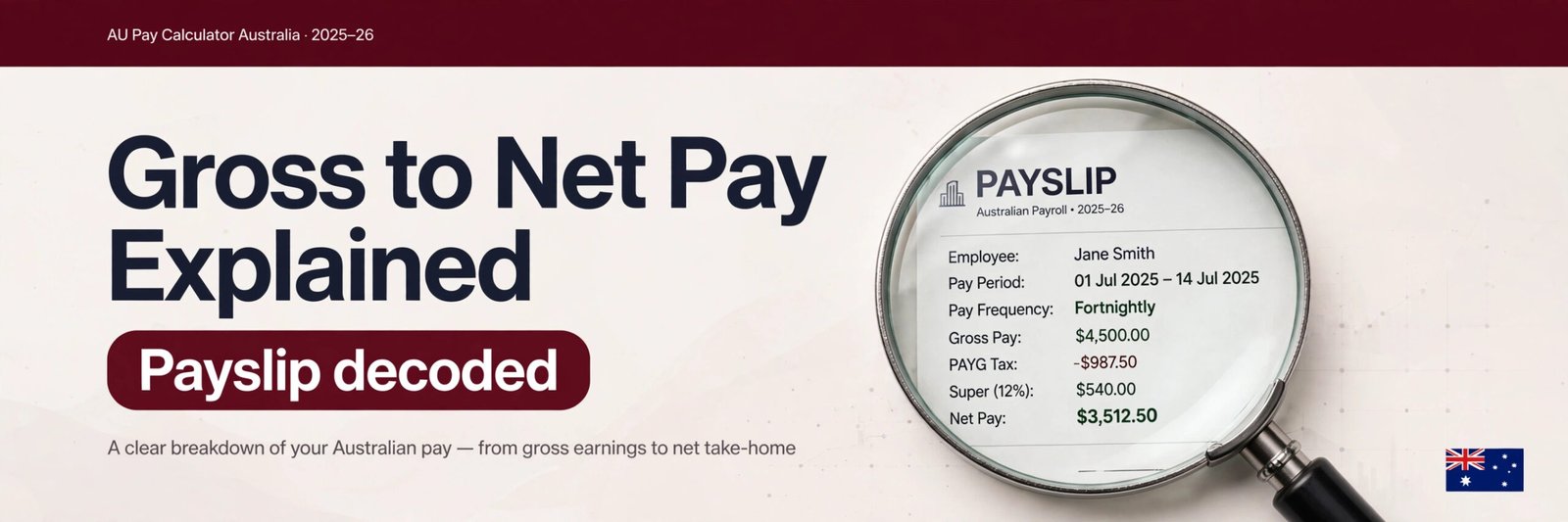
Your contract says one number; your bank account shows a smaller one. The journey from gross pay (your salary before anything is taken off) to net pay (what actually lands in your account) runs through PAYG withholding, the Medicare levy, and sometimes extras like HECS repayments or salary sacrifice — all calculated under the 2025–26 tax rules.
This guide walks through every line of a typical Australian payslip, with a fully worked example, so you can read your own payslip with confidence and spot when something looks wrong.
Gross Pay vs Net Pay: The Definitions
- Gross pay is your total earnings before deductions — your annual salary, or gross earnings per pay period. It is the number on your job offer.
- Net pay (take-home pay) is what is deposited after your employer withholds tax and other compulsory amounts.
- Taxable income is gross pay minus any pre-tax deductions (like salary sacrifice into super) — the figure the ATO actually taxes.
The deductions between gross and net fall into two camps: compulsory withholdings your employer must take (PAYG income tax, Medicare levy, HECS repayments if you have a study debt) and voluntary pre-tax deductions you have chosen (salary sacrifice, additional super contributions).
Anatomy of an Australian Payslip
| Payslip line | What it means |
|---|---|
| Gross earnings | Your pay for this period before any deductions. |
| PAYG withholding | Income tax your employer withholds and sends to the ATO, calculated from the official tax tables on your annualised income. |
| Medicare levy | Usually bundled inside the PAYG figure on your payslip at 2% of taxable income — it is not a separate line item on most payslips. |
| HECS/HELP withholding | Extra withholding if you ticked “yes” to having a study debt on your Tax File Number declaration — only when your income is above $67,000 (2025–26). |
| Salary sacrifice | Pre-tax amounts redirected to super or benefits under an agreement with your employer. |
| Net pay | The amount paid into your account. |
| Superannuation (SG) | Shown for information — paid by your employer on top of your gross pay (12% in 2025–26), not deducted from it. |
One constant source of confusion: super is not taken out of your gross pay unless you have a salary-sacrifice agreement. The SG amount on your payslip is your employer’s contribution, paid in addition to your salary.
Worked Example: $78,000 Salary, Paid Fortnightly
Take a full-time employee on $78,000 a year, paid fortnightly, with no HECS debt and no salary sacrifice. First, the annual tax under 2025–26 resident rates:
- 16% bracket: $26,800 × 16% = $4,288
- 30% bracket: ($78,000 − $45,000) × 30% = $9,900
- Income tax total: $14,188
- Medicare levy (2%): $1,560
- Total annual deductions: $15,748 → take-home $62,252
Divided across 26 fortnights, the payslip reads:
| Line | Fortnightly amount |
|---|---|
| Gross earnings | $3,000.00 |
| PAYG withholding (income tax) | −$545.69 |
| Medicare levy (within PAYG) | −$60.00 |
| Net pay | $2,394.31 |
| Super (12%, employer, info only) | $360.00 |
Your employer annualises your pay — it multiplies your fortnightly gross by 26, estimates annual tax from the ATO tables, then divides back down. That is why a mid-year pay rise or bonus can make one payslip look odd: the tables assume the new level applies all year. Run the same maths yourself any time with our free gross to net pay calculator.
Why Your Net Pay Changes Between Payslips
- Overtime and bonuses: Extra earnings are annualised, so a bonus fortnight is withheld at a higher assumed rate — often producing a refund at tax time. See how bonus tax and overtime pay are handled.
- HECS debt: Tick “yes” to a study debt and extra withholding applies once income passes $67,000 — 7% at this level in 2025–26, which is a big slice. The HECS calculator shows the exact impact.
- Salary sacrifice: Redirecting $100 a fortnight into super cuts taxable income by $2,600 a year, saving roughly $780 in tax at the 30% bracket — while the contribution itself is only taxed 15% in the fund.
- Tax-free threshold claimed on two jobs: Claim the $18,200 threshold on both jobs and both employers withhold too little — you will owe the difference at tax time. Claim it on only one job.
- Leave payouts: Unused annual leave paid on termination is taxed under special rules (often at a flat-ish marginal rate) — see our guide to annual leave loading.
Common Payslip Mistakes to Watch For
- Wrong tax-free threshold status — the single most common cause of a tax bill. Check your TFN declaration.
- Super paid late or short — SG is due quarterly at the latest (moving to payday super from 1 July 2026). Your payslip shows the accrual; your fund shows the cash.
- Allowances treated as tax-free — most allowances (travel, tools, uniform) are taxable income unless genuinely exempt.
- Casual loading confusion — the 25% loading is part of gross pay, not an add-on after tax. Our casual loading calculator breaks it down.
Payslip vs Tax Return: Why They Differ
Your payslip is an estimate; your tax return is the final settlement. PAYG withholding uses the ATO’s tax tables, which assume your current pay rate continues all year and know nothing about your deductions, second job, investment income or offsets. Common reasons the two differ:
- Deductions: Work expenses you claim at tax time were never in your payslip maths — this is the main source of refunds.
- Multiple income sources: Interest, dividends, freelance income and second jobs are not on your payslip but are on your return.
- Offsets: The Low Income Tax Offset (up to $700) and SAPTO for seniors are only applied at tax time, never in PAYG withholding.
- HELP repayments: If your employer withholds HECS amounts but your actual repayment income ends up below $67,000, the excess comes back as a refund.
- Medicare levy adjustments: Exemptions, reductions and the surcharge are all settled at tax time, not on the payslip.
A big refund feels good but means you lent the government money interest-free all year; a big bill means your withholding was short. The ideal is close to zero either way — and the way to get there is checking your TFN declaration, claiming the tax-free threshold on only one job, and updating your employer when your HECS status changes.
Special Pay Situations Worth Knowing
- Termination payouts: Unused annual leave and long service leave paid out on termination are taxed under concessional rules — unused annual leave is generally taxed at a flat 32% including Medicare, which can beat your marginal rate. See the annual leave calculator.
- Redundancy payments: Genuine redundancy payments include a tax-free component (a base amount plus an amount per year of service, indexed yearly) with the remainder taxed concessionally. The redundancy pay calculator handles the thresholds.
- Back pay and lump sums: Lump-sum arrears can be spread across the years they relate to for tax purposes (lump sum payment in arrears offset), sometimes saving thousands versus being taxed all in one year.
- Foreign income and residency: Working holiday makers and non-residents are taxed under completely different scales — no tax-free threshold and no Medicare levy. If your residency status is unclear, get advice before assuming resident rates.
FAQ
How do I calculate gross to net pay in Australia?
Take your gross annual salary, apply the 2025–26 resident tax brackets ($18,200 tax-free, then 16%, 30%, 37%, 45%), subtract 2% Medicare levy, and subtract any HECS repayments or salary sacrifice. Our gross to net calculator does this instantly, including per-period figures.
Why is my net pay less than expected?
The usual suspects: HECS/HELP withholding (up to 10% of income), the tax-free threshold claimed on the wrong job, a bonus annualised at a higher rate, or salary-sacrifice deductions you forgot about. Compare your payslip to the calculator line by line.
Is super deducted from my gross pay?
No — the 12% Superannuation Guarantee is paid by your employer on top of your salary. It only reduces your take-home if you voluntarily salary-sacrifice extra into super.
Is the Medicare levy separate from income tax on my payslip?
On most payslips it is bundled into the single PAYG withholding figure rather than shown separately. It is still 2% of your taxable income, calculated at tax time.
What is the difference between gross to net and net to gross?
Gross to net starts with your salary and works out your take-home. Net to gross works backwards: you set a target take-home pay and it calculates the gross salary you would need. Try the net to gross calculator when negotiating offers.
Do I pay tax on my full gross salary?
You pay tax on your taxable income, which is gross salary minus pre-tax deductions like salary sacrifice. Without any salary sacrifice, taxable income equals gross salary for most employees.
Conclusion
Reading a payslip is a five-minute skill that pays off every fortnight: gross earnings, PAYG withholding (tax plus the 2% Medicare levy), any HECS or salary-sacrifice lines, and the net that hits your account — with super sitting alongside, not inside, the deductions. If any line does not match, the gross to net pay calculator gives you the 2025–26-correct figure to compare against, and the income tax calculator covers the annual picture.